A practical code-level review for laboratories and practices preparing for CMS's preliminary CY 2027 Clinical Laboratory Fee Schedule rates.
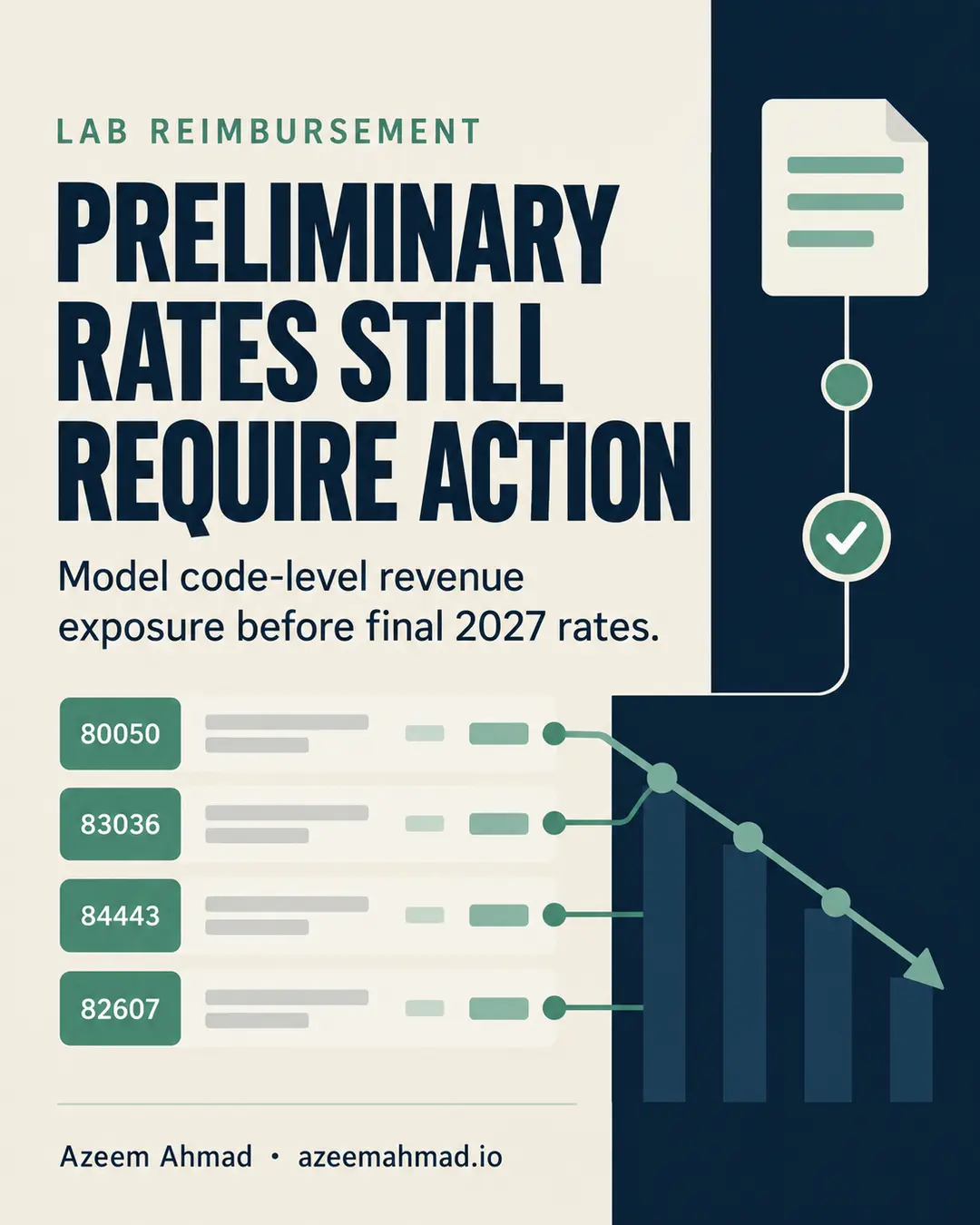
CMS published preliminary calendar year 2027 Clinical Laboratory Fee Schedule rates on September 21, 2026. The agency reports that the codes with private-payor weighted medians show an average potential change of about 16% below 2026 rates. Those figures are preliminary, not final. They are still detailed enough for laboratories and practices to model exposure, validate assumptions, and use the public comment window before operational decisions become urgent.
Read the preliminary data at the code level
CMS used 2026 reported private-payor data to calculate weighted medians for 1,528 HCPCS codes. Of the codes with comparable 2026 rates, 1,171 show a lower weighted median, 186 show a higher median, and 169 are unchanged. Category averages also vary: CMS lists potential changes of minus 16% for chemistry, minus 22% for molecular pathology, and minus 23% for genomic sequencing.
A category average is not a budget. Export the codes your organization actually bills, attach current Medicare volume and allowed amounts, and compare the preliminary rate at the individual-code level. Weighting the change by your own service mix produces a more useful exposure estimate than applying the headline percentage across total laboratory revenue.
Separate the market signal from the effective rate
CMS says a test's CLFS payment may not be reduced by more than 15% per year from 2027 through 2029. That phase-in means a weighted median can signal a larger market movement than the first-year payment reduction. Model both the statutory cap and the underlying median so leadership can see the near-term impact and the possible multi-year direction.
The preliminary release is also not the final fee schedule. CMS expects to publish final 2027 rates in November, with rates effective January 1, 2027. Keep every model labeled preliminary and retain the source file and date used.
Use the comment window as an evidence deadline
CMS's September 24 MLN newsletter states that comments and reconsideration requests are due October 21, 2026. If a code appears materially inconsistent with the underlying data or methodology, organize the evidence now: code, reported issue, volume, payment comparison, source data, and a concise explanation of the requested review.
Operationally, assign one owner for rate analysis, one for evidence validation, and one for finance decisions. Re-run the code-level model when CMS publishes final rates, update forecasts and fee-schedule controls, and monitor January remittances for configuration or pricing errors.
Turn the release into a controlled readiness review
A useful review produces four outputs: a code-level impact file, a ranked list of material exposures, a record of any comments submitted, and a January payment-validation plan. Practices that send tests to outside laboratories should also confirm whether any contracts, patient estimates, or service-line decisions depend on Medicare benchmarks.
The practical lesson is simple: preliminary does not mean ignorable. It means the final number can still change, but the operational work should already be organized.
Practical takeaway
Model the rates against your actual HCPCS mix and Medicare volume.
Separate preliminary weighted medians from the annual 15% reduction cap.
Preserve the October 21 comment and reconsideration deadline.
Re-run the model when CMS publishes final rates in November.
Validate January remittances against the final fee schedule.