What Adirondack Health’s public case shows about contract variance, underpayment detection, and why a clean denial queue can still hide revenue leakage.
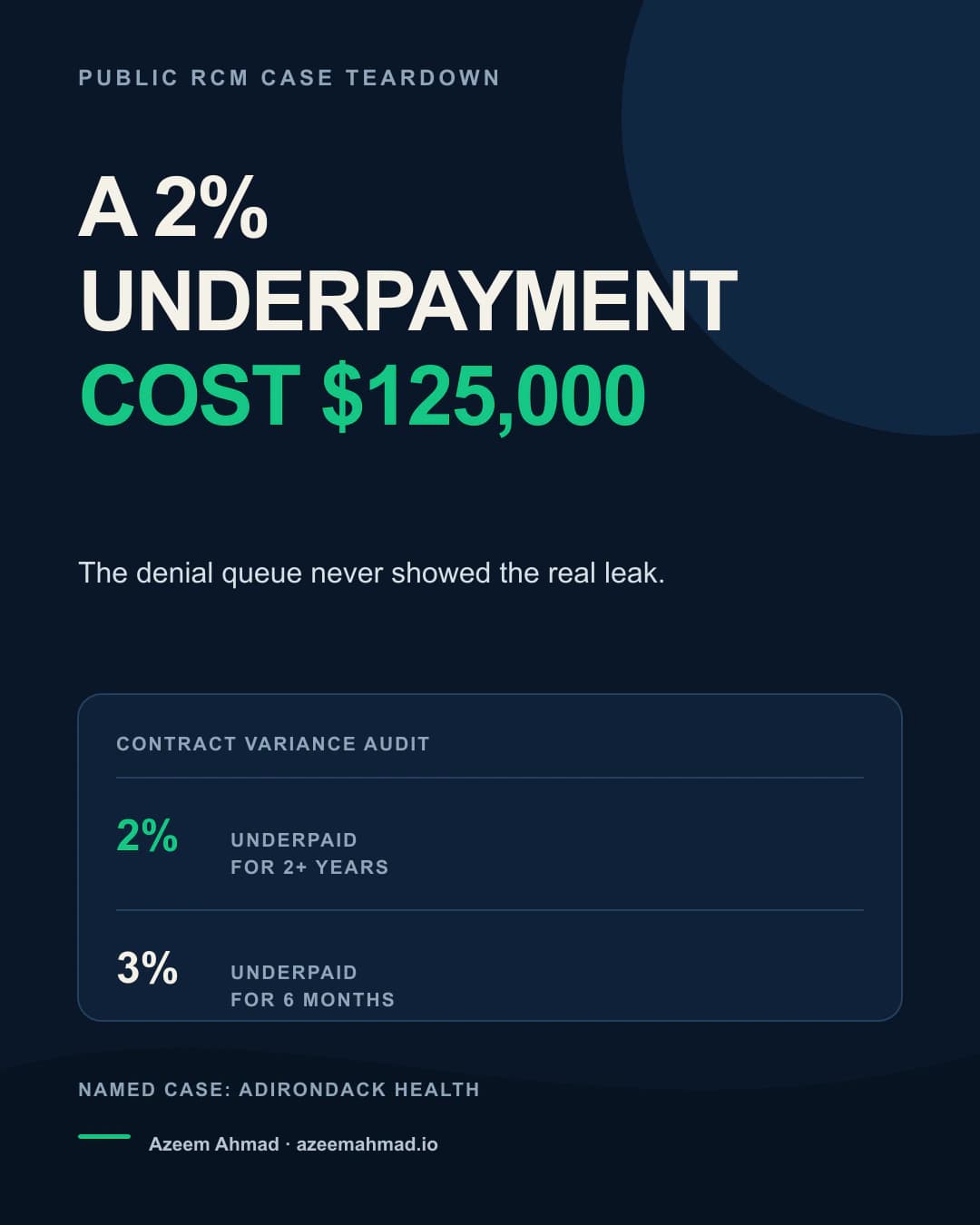
A public NAHRI case study reports that Adirondack Health recovered $125,000 after contract analysis identified two payer underpayment patterns: 2% for more than two years and 3% for six months. The named results are attributed to Adirondack Health and TruBridge; they are not an ERG client result or an independently audited finding. The operational lesson is still useful: a claim can pay and remain financially wrong.
The leak was not sitting in the denial queue
A denial workflow is designed to find claims a payer rejected or did not pay. Contract underpayments behave differently. The claim may adjudicate, post, and close with a plausible payment while still falling below the contracted amount. If the team measures only denials and unpaid A/R, that variance can disappear into normal payment activity.
According to the published case, Adirondack Health compared payer contract terms with actual paid claims. During the first 10 months, that review identified one payer underpaying by 2% for more than two years and another underpaying by 3% for six months.
Small percentages become large when the pattern repeats
A 2% difference does not look dramatic on one remittance. Repeated across volume and time, it became material enough to support a $125,000 settlement. That is why dollar variance, claim volume, and duration belong in the same review—not in separate reports.
The useful operator question is not only whether a claim paid. It is whether the allowed amount and payment matched the applicable contract terms, fee schedule, and claim circumstances. Any payer-specific interpretation should be validated against the current contract and supporting remittance data before escalation.
Build a variance queue beside the denial queue
Start with high-volume services and payers. Compare expected reimbursement with posted payment, group recurring differences by payer and service, and set a materiality threshold that makes review manageable. Preserve the contract language, claim sample, remittance evidence, calculation method, and correspondence used to support the variance.
Assign each recurring pattern an owner and a next action. A variance may require validation, payer inquiry, corrected configuration, escalation, or documented closure. Reconciliation is most useful when it produces an accountable work queue rather than another dashboard nobody owns.
Recovery is only half the job
A settlement addresses the historical loss. The durable control is preventing the same variance from continuing. After resolution, update the expected-rate logic, confirm the payer correction, review new remittances, and monitor the affected services for recurrence.
The case also reported a 20% decrease in A/R days, a 40% reduction in denial rates, and a 22% increase in paid claims after the broader RCM implementation. Those outcomes were reported together, but the underpayment lesson stands on its own: payment posting should answer both ‘did we get paid?’ and ‘did we get paid correctly?’
Practical takeaway
Reconcile actual payment against expected contract reimbursement—not only billed charges.
Prioritize recurring variance by payer, service, dollars, volume, and duration.
Keep contract language, remittance data, calculations, and correspondence together.
Give every material variance an owner, due date, and escalation path.
Confirm the payer correction on new claims after any historical recovery.