How skilled nursing facilities can use the FY 2025 PEPPER to prioritize targeted claim, coding, documentation, medical-necessity, and length-of-stay review without treating an outlier as proof of error.
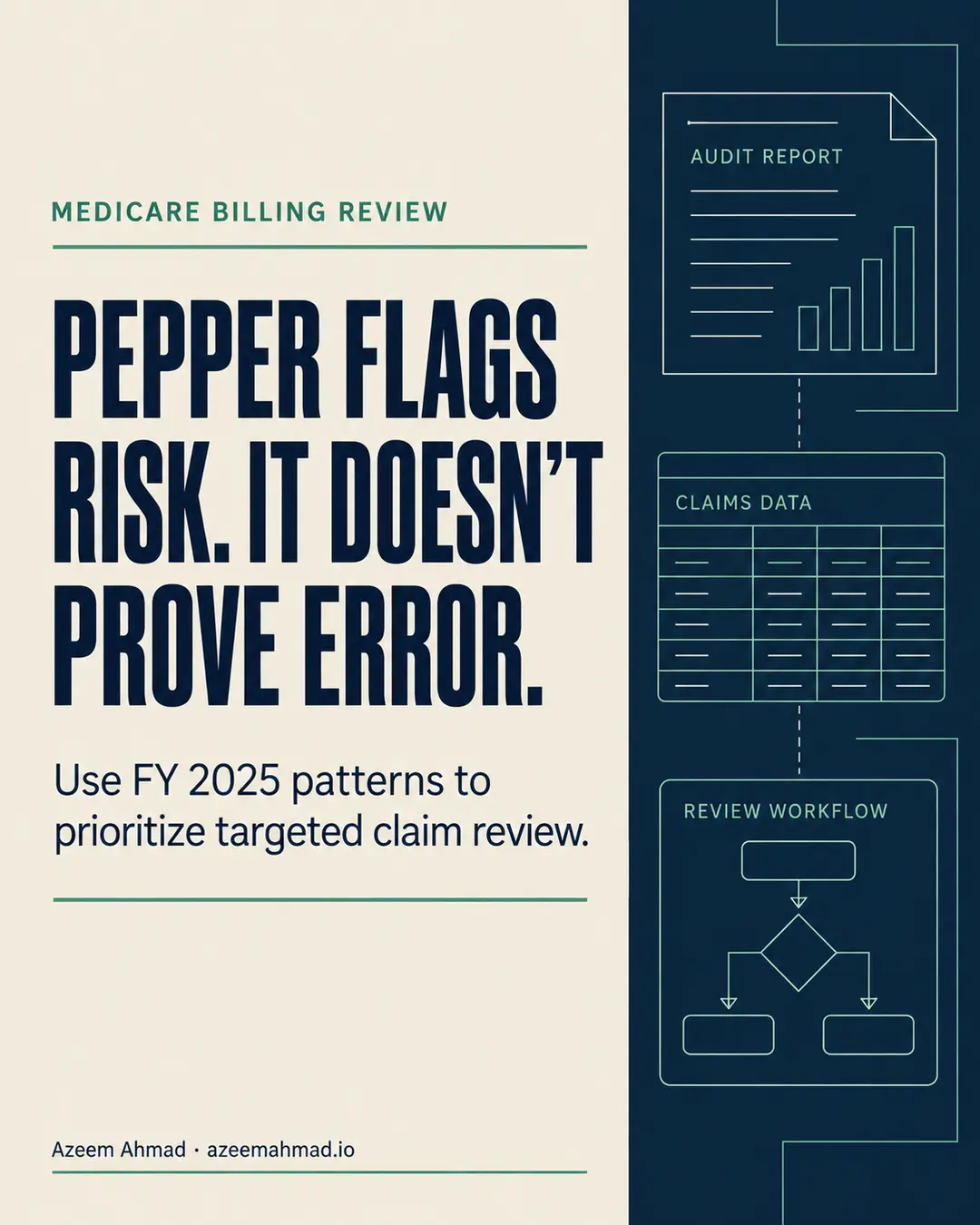
CMS released the fiscal year 2025 Program for Evaluating Payment Patterns Electronic Report for skilled nursing facilities in September 2026. PEPPER gives each facility provider-specific Medicare statistics for target areas that may be associated with improper payments, including billing patterns, coding concerns, medical necessity, and length-of-stay patterns. It is a useful signal, but it is not an error determination.
Use PEPPER to prioritize—not to pronounce judgment
CMS’s PEPPER resources state that the report does not identify whether payment errors are present. That distinction matters. An outlier may reflect documentation or coding risk, but it may also reflect a real difference in the facility’s patient population, services, or operating model.
The right response is a focused review, not an automatic conclusion that claims were billed incorrectly. Treat the report as a map showing where additional evidence is worth examining.
Read comparison and trend data together
SNF PEPPER compares provider-specific target-area statistics with national, Medicare Administrative Contractor jurisdiction, and state data. It also gives multiple reporting periods so a facility can see whether a pattern is new, persistent, or moving in the wrong direction.
Start with the highest-priority target area, then review the percentile position and the trend. A single high result deserves context. A persistent or rising pattern deserves a clearly owned audit plan.
Move from outlier to a targeted claim sample
Pull a focused sample tied to the target area. Review the claim, diagnosis and procedure coding, supporting clinical documentation, medical necessity, length of stay where relevant, and the remittance or denial history as one record. Looking at the claim without the documentation can create a false explanation.
Classify what the sample shows: supported variation, documentation weakness, coding inconsistency, workflow failure, or another cause. Then document the corrective action, owner, due date, and method for checking whether the pattern changes.
Make access and follow-through part of the control
CMS says a facility’s authorized official or access manager can download PEPPER through the secure portal. A security official can also request the PEPPER business function in the Identity & Access system and receive approval from the authorized official or access manager.
Assign one report owner before the file becomes another forgotten download. The practical rule is simple: PEPPER tells the team where to look; the claim and documentation review determines what actually happened.
Practical takeaway
Do not treat a PEPPER outlier as proof of a payment error.
Compare national, MAC-jurisdiction, and state benchmarks with the multi-period trend.
Audit a focused claim sample tied to the highest-priority target area.
Review billing, coding, documentation, medical necessity, and remittance history together.
Record the finding, corrective action, accountable owner, and follow-up date.